Reading Time: 6 min
“Can I get an appointment this Friday?”
Every clinic has heard that question.
Sometimes the answer is yes.
Sometimes it’s…
“Let me check with the doctor and call you back.”
Now imagine hearing that as a patient.
You don’t know whether the slot is actually available. You don’t know if you’ll need to rearrange your day. And if you don’t hear back for hours, there’s a good chance you’ll book somewhere else.
That’s the thing about virtual care.
Patients aren’t just judging the consultation anymore. They’re judging everything that happens before it.
Here’s what patients actually expect
They don’t expect magic.
They expect things to work.
A good booking experience should feel something like this:
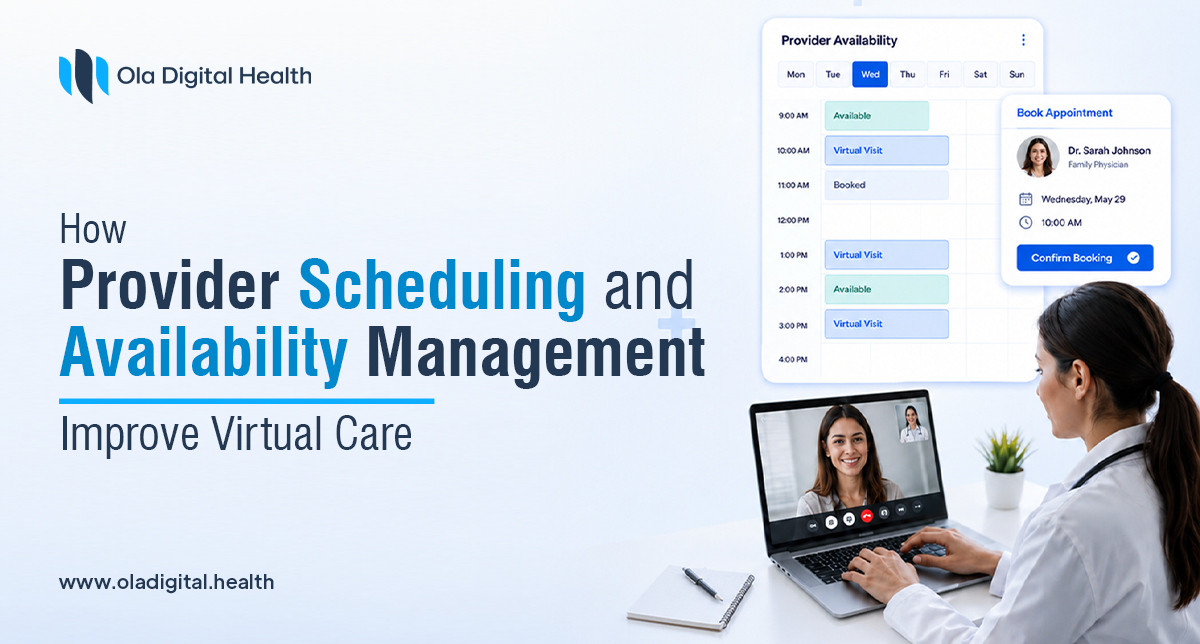
✔ They can see available time slots.
✔ They know which provider they’re booking.
✔ They receive confirmation immediately.
✔ They don’t get a call saying the doctor isn’t available anymore.
✔ Joining the consultation is simple.
Notice something?
None of these expectations have anything to do with the consultation itself.
They’re all about scheduling.
And that’s exactly how provider scheduling improves telehealth. When booking is organised, the rest of the care journey usually feels organised too.
Here’s where clinics usually struggle
Managing one doctor’s calendar isn’t particularly difficult.
Managing ten?
That’s a different story.
Every provider has different:
- Working hours
- Consultation types
- Break timings
- Holidays
- Follow-up schedules
- Areas of expertise
Now multiply that across an entire clinic.
Without a proper scheduling system, administrative teams often end up juggling spreadsheets, emails, phone calls, and multiple calendars just to confirm appointments.
It works…
Until it doesn’t.
A quick reality check
Imagine this happens on a Monday morning.
One provider calls in sick.
Another extends a consultation by 20 minutes.
Three patients need to reschedule.
A new urgent appointment comes in.
If every change has to be handled manually, the entire day starts falling apart.
Patients wait longer.
Providers run behind schedule.
Staff spend more time fixing calendars than helping patients.
This is why provider scheduling software for telehealth clinics has become less of a convenience and more of a necessity.
What changes when scheduling is connected?
Instead of asking staff to coordinate everything manually, a connected scheduling system keeps appointments, providers, and availability in sync.
That means teams can spend less time asking,
“Who’s free?”
And more time helping patients.
With Ola Digital Health, healthcare organisations can configure provider workflows, consultation types, reusable service templates, and appointment management within one platform, making it easier to organise schedules as practices grow.
Signs your scheduling process needs improvement
If you’re seeing any of these, your scheduling workflow may be holding your clinic back:
- Patients frequently call to confirm appointments.
- Providers are occasionally double-booked.
- Staff manually update multiple calendars.
- Rescheduling one appointment creates a chain of changes.
- Patients wait days for available slots even though providers have gaps in their schedules.
These small inefficiencies add up quickly, especially for growing practices.
And for organisations running a telehealth platform for multi-provider clinics, they become even harder to manage because every provider follows a different schedule, offers different services, and has different availability.
The good news? Most of these challenges aren’t caused by the providers themselves. They’re usually a sign that the scheduling process has outgrown the tools supporting it.
So, what does good provider scheduling actually look like?
If you’re evaluating your current virtual care setup, here’s a simple way to think about it.
Ask yourself these questions:
- Can patients see real-time provider availability?
- Can providers easily update their schedules?
- Is it easy to reschedule appointments without creating chaos?
- Can your team manage multiple providers from one place?
- Do patients receive appointment updates automatically?
If you answered “no” to more than one of these, your scheduling process might be creating more work than it should.
The good news is that these challenges are usually operational, not clinical. They’re often solved by having the right systems in place.
Ola Digital Health helps healthcare organisations manage provider availability, consultation workflows, reusable service templates, and appointment scheduling through one connected platform, making it easier to coordinate care across teams.
Scheduling isn’t just about calendars anymore
Many clinics start with a shared calendar or a booking tool.
That works…until the practice grows.
Add more providers, introduce new consultation types, or expand to multiple locations, and suddenly you’re managing dozens of moving pieces every day.
This is why many growing healthcare organisations invest in a white label telehealth platform. Instead of stitching together separate tools for appointments, provider management, and patient communication, they get everything working together in one branded experience.
It makes life easier for patients, but it also makes life easier for the people running the clinic.
A quick stat that’s hard to ignore
According to the American Medical Association (AMA), physician use of telehealth increased from 25.1% in 2018 to 71.4% in 2024. Virtual care has become a routine part of healthcare, which means operational efficiency is no longer optional. As more consultations happen online, reliable scheduling becomes just as important as the consultation itself.
That’s one reason healthcare organisations are increasingly choosing telehealth turnkey solutions. Instead of spending months building scheduling, provider management, patient communication, and consultation workflows separately, they can launch with technology that’s already designed to support virtual care from day one.
Final thoughts
Patients don’t remember how your scheduling system works.
They remember how it made them feel.
Was booking an appointment quick?
Did they meet the right provider at the right time?
Did everything happen without unnecessary back-and-forth?
Those moments shape the overall care experience just as much as the consultation itself.
Whether you’re managing a single practice or a telehealth platform for multi-provider clinics, investing in better scheduling isn’t just about improving operations. It’s about giving patients one less thing to worry about while helping your team work more efficiently.
Ready to learn more? Get in touch today.
Frequently Asked Questions
How does provider scheduling improve telehealth?
It helps patients book appointments more easily, reduces scheduling conflicts, and ensures providers have clear visibility into their availability. The result is a smoother experience for both patients and healthcare teams.
What should I look for in provider scheduling software for telehealth clinics?
Look for features like real-time provider availability, appointment management, consultation workflows, follow-up scheduling, automated notifications, and support for multiple providers.
Why do healthcare businesses choose a white label telehealth platform?
A white label telehealth platform allows healthcare organisations to deliver a branded virtual care experience without having to build the technology from scratch. It combines patient-facing features with operational tools that help clinics scale more efficiently.
What are telehealth turnkey solutions?
Telehealth turnkey solutions are ready-to-deploy platforms that include essential capabilities like scheduling, provider management, patient communication, and consultation workflows, helping organisations launch or expand virtual care faster.